

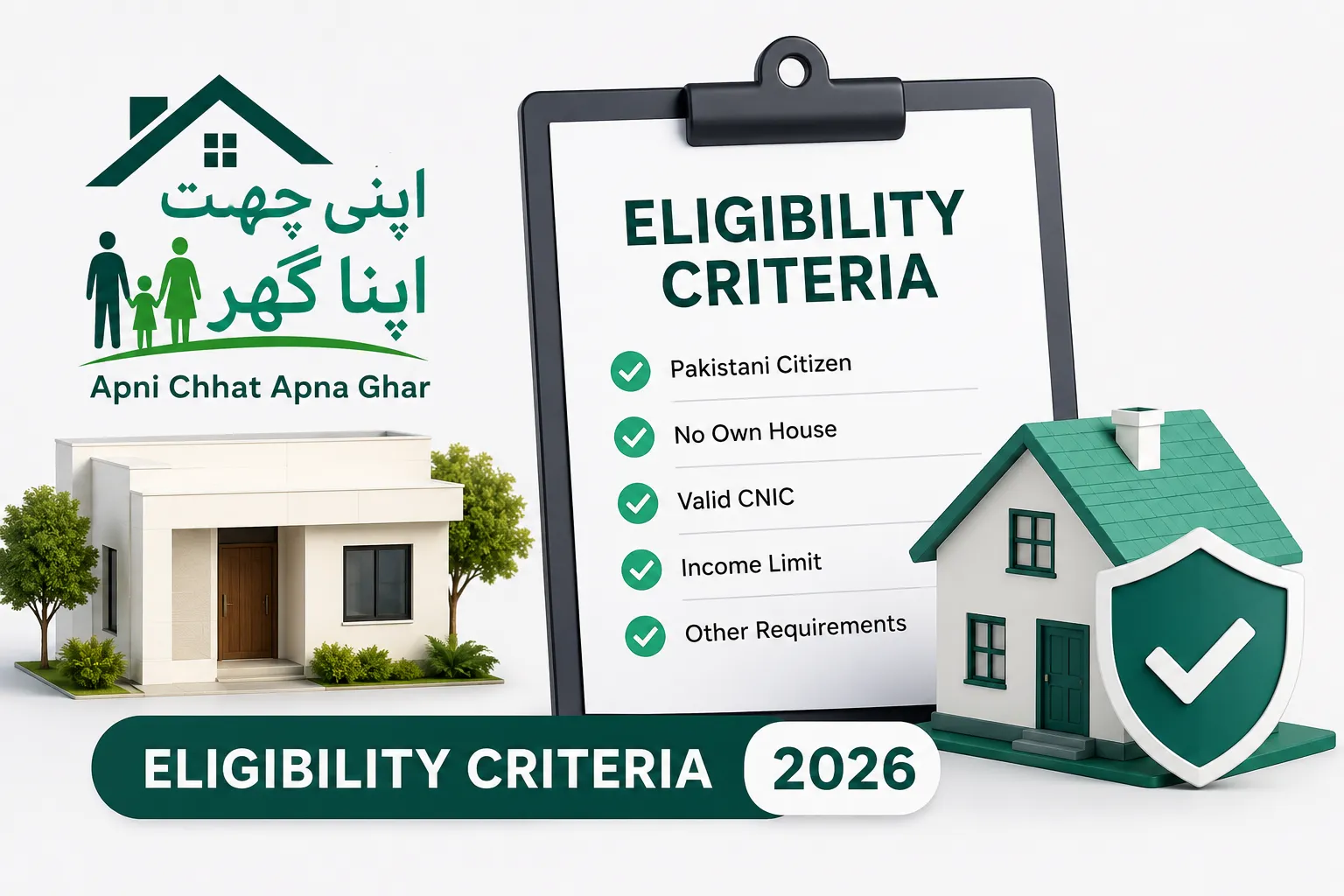
If you own a small piece of land but can’t afford to build on it, Punjab’s Apni Chhat Apna Ghar scheme was designed with exactly this problem in mind. Launched under Chief Minister Maryam Nawaz Sharif, the programme offers interest-free construction loans to low and middle-income families who already own a residential plot but need financial help to actually build a house on it.
Before anyone rushes to apply, though, it’s worth understanding what the government is actually asking for. Housing schemes like this tend to attract huge numbers of applications, and a large chunk get stuck or rejected simply because people didn’t check the fine print first.
Who qualifies for Apni Chhat Apna Ghar
The basic eligibility rests on a handful of conditions. First, you need to be a permanent resident of Punjab, and your address has to match what’s on official government records — mismatches here are one of the more common reasons applications stall.
You’ll also need a valid, NADRA-issued CNIC. An expired card or incorrect details on it can delay your application or get it cancelled outright, so it’s worth double-checking this before you even start the process.
Plot ownership matters a lot too. Applicants have to legally own an eligible residential plot, and there are size limits attached: up to 5 marla for plots in urban areas, and up to 10 marla in rural areas. Anyone who owns more land than that isn’t eligible, and government departments do verify ownership before approving anything.
Beyond that, applicants must meet the minimum legal age needed to enter into a financial agreement, and the scheme is generally aimed at low and middle-income households — authorities may ask for income-related details during verification. Family and personal information also needs to be accurate, since any mismatch with official records can hold up the process.
Who gets turned away
Not every application makes it through. People get disqualified for reasons like not being a Punjab resident, having an invalid or expired CNIC, failing property verification, owning land beyond the allowed limit, or submitting false information. Incomplete documents are another common trip-up.
Required documents
Applicants are advised to keep the following on hand before applying: a valid CNIC, a recent passport-size photo, an active mobile number, residential address details, and property ownership documents. Depending on the case, additional supporting documents may be requested.
How the verification process works
Once an application is submitted, it goes through several checks. NADRA records are used to verify identity, land ownership is cross-checked against government databases, and personal information along with submitted documents is reviewed carefully. Only after clearing these stages does an application move to final approval, with selected applicants receiving official notification.
Common mistakes
A lot of rejections come down to avoidable errors — incorrect CNIC information, an invalid mobile number, missing paperwork, wrong property details, or simply not meeting the basic eligibility conditions. Owning property beyond the permitted size is another frequent issue. Reviewing an application carefully before hitting submit can save a lot of back-and-forth later.
A few practical tips
Applicants are encouraged to submit only one application, since duplicate submissions can complicate verification. Keeping CNIC details updated, uploading genuine and clear documents, and cross-checking every entry against official records before submission all help avoid unnecessary delays.
The Punjab Government has indicated that eligibility criteria, registration timelines, or documentation requirements could be revised going forward, so applicants are advised to rely on official government channels rather than unverified social media posts for the latest updates.
